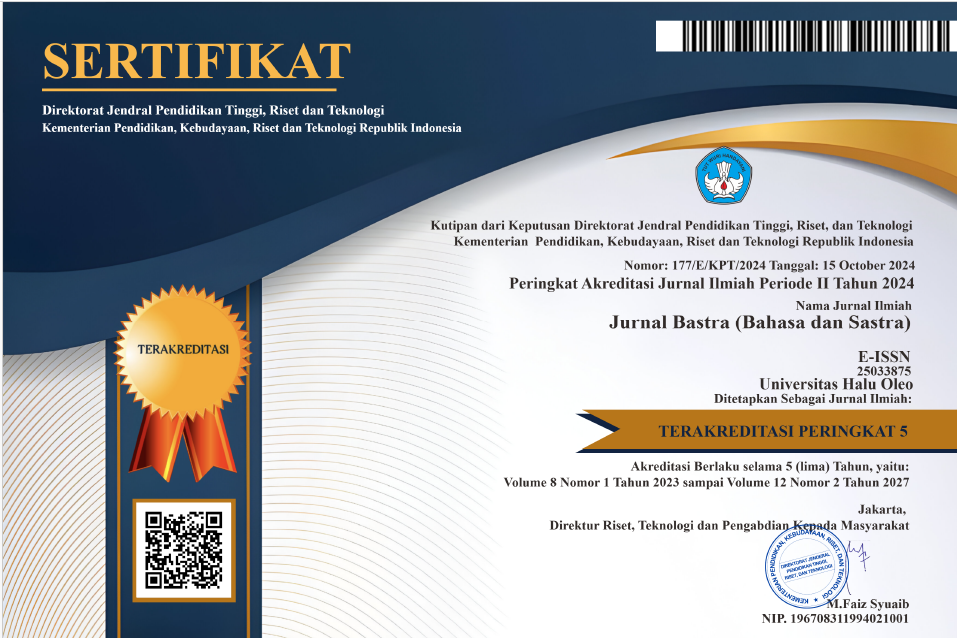
ANALISIS SINONIMI VERBA SCREAM, SHOUT, DAN YELL DALAM COCA: TINJAUAN DISTRIBUSI, KOLOKASI, DAN PROSODI SEMANTIK
DOI:
https://doi.org/10.36709/bastra.v11i2.2012Keywords:
Corpus Analysis, Collocation, Frequency, Synonymy, COCAAbstract
This study analyses the synonymous verbs ‘scream’, ‘shout’, and ‘yell’ using data from the Corpus of Contemporary American English (COCA) spanning the period of 1995-2019. This specific timeframe was selected to capture significant shifts in communication and technology. Although these words share a similar core meaning, this research aims to demonstrate that their usage is not entirely identical. The study focuses on the distribution, frequency, colligation, and collocation of the three verbs across different registers and time periods. A mixed-methods approach, combining quantitative and qualitative methods, was employed. The quantitative method was used to calculate word frequencies, while the qualitative method was applied to analyse concordances and collocations. The findings reveal that ‘scream’ has the highest overall frequency of use, while ‘yell’ has the lowest. All three words are predominantly used as verbs compared to other word classes. In terms of registers, ‘scream’ and ‘shout’ appear most frequently in the fiction register, whereas ‘yell’ is most common in the TV register. All three words are least used in the academic register. Regarding collocation, only ‘shout’ exhibits a positive semantic prosody, while ‘scream’ and ‘yell’ tend to have a negative semantic prosody. These findings reinforce the evidence that synonymous words possess different nuances in meaning and usage, depending on their context and communicative purpose.
References
Chee, A. J. E., Szabo, C. Z., & Ambrose, S. (2025). Measuring Emotion Recognition Through Language: The Development and Validation of an English Productive Emotion Vocabulary Size Test. Languages, 10(9), 204.
Cosgrove, S. (2020). Controlling the clock – how showing and telling impact time in short-short fiction. New Writing, 17, 101 - 106. https://doi.org/10.1080/14790726.2019.1566369.
Davies, M. (2009). The 385+ million word Corpus of Contemporary American English (1990―2008+): Design, architecture, and linguistic insights. International Journal of Corpus Linguistics, 14, 159-190. https://doi.org/10.1075/ijcl.14.2.02dav.
Diaz, B. (2021). Corpus Linguistic Methodology as an Advanced Conversion Design for Social Science Research. International Journal of Multiple Research Approaches, 13(3), 254-266. https://doi.org/10.29034/ijmra.v13n3a2.
Gayathri, A., and S. Vijayalakshmi. (2025). Unraveling the Contextual Nuances of Say, Tell, Talk and Speak: A Corpus-Based Study. The International Journal of Communication and Linguistic Studies, 23(3), 95-109.
Aldunate, N., & González-Ibáñez, R. (2017). An Integrated Review of Emoticons in Computer- Mediated Communication. Frontiers in Psychology, 7, 2061. https://doi.org/10.3389/fpsyg.2016.02061.
Liu, Y. (2023). A corpus-based comparative study of English synonyms: Taking improve, promote, and strengthen as an example. Scholars International Journal of Linguistics and Literature, 6(9), 399-403 . https://doi.org/10.36348/sijll.2023.v06i09.005.
Marmolejo-Ramos, F., Vaci, N., Reali, F., & Milin, P. (2025). The interplay of sensory and motoric information on processing emotions in narrative texts. Journal of Cultural Cognitive Science, 9, 243 - 254.
Motlagh, N., & Nezhad, M. (2021). Investigation on Productivity of Synonym Words with Different Semantic Prosody in English. International Journal of Linguistics and Translation Studies 2(3), 65-75. https://doi.org/10.36892/ijlts.v2i3.146.
Muangmeeka, P. (2022). A corpus-based study of English near-synonyms: join, attend and participate. Thammasat University.
Naqvi, S. (2025). The Rapid Growth of Digital Communication and Social Media’s Influence on Language. Social Science Review Archives, 3(1), 1672-1686.
Pérez-Paredes, P., Curry, N. & Jiménez, P. (2025). Integrating critical corpus and AI literacies in applied linguistics: a mixed-methods study. Computer Assisted Language Learning. 1- 27. https://doi.org/10.1080/09588221.2025.2569351
Russnes, M. (2024). Semantic prosody, semantic transfer and semantic change. ICAME Journal, 48(1), 2024. 67-88. https://doi.org/10.2478/icame-2024-0004
Sadiqzade, Z. (2025). The Linguistic Expression of Emotion: A Cross-Cultural Analysis. EuroGlobal Journal of Linguistics and Language Education, 2(3), 42-54. https://doi.org/10.69760/egjlle.2500195.
Sridhanyarat, K., & Phoocharoensil, S. (2023). A corpus-based investigation of English near- synonyms: Assess, evaluate, and measure. Humanities, Arts and Social Sciences Studies, 208–219. https://doi.org/10.14456/hasss.2023.19
Yusu, Xu (2014). On the Application of Corpus of Contemporary American English in Vocabulary Instruction. International Education Studies, 7(8), 68-73. https://doi.org/10.36348/sijll.2023.v06i09.005.